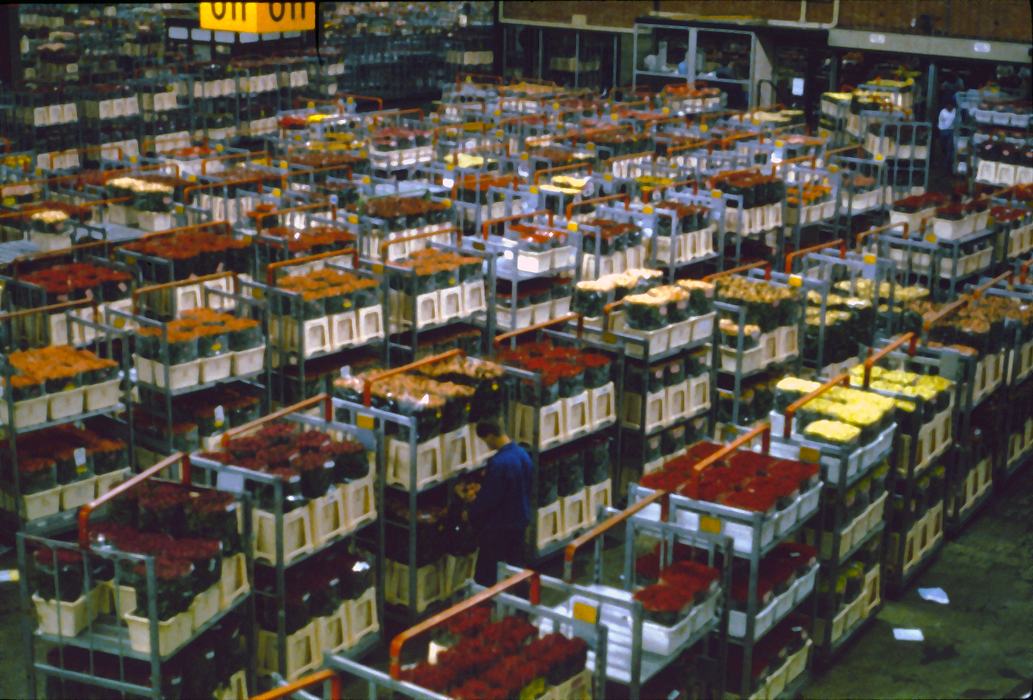
In 1989, I was one of about forty Extension Agents to be selected to tour 7 countries in western Europe in order to see agriculture in another part of the world. This program was called “Agriculture in the World” and this 2-week tour opened my eyes to not only food production but an entirely different culture of those who still remembered what it was to be without food during World War II. During our trip, we spent three days in Paris where we stood in front of the painting of the Mona Lisa. Mona was much smaller than I expected. We ate dinner in the Eiffel Tower which was breath taking at night.
Our first stop was Brussels, Belgium and from there we headed northward to Amsterdam and Holland. In this part of the world, most skies are overcast with days that feature a lot of gray color for those who live there. But just north of Amsterdam, our group visited a ten-acre warehouse where different species of flowers were being packaged to be shipped all across the globe. To see these vibrant colors was exciting and life changing and it appeared that their colors made up for the overwhelming gray landscape. Many of us wanted to purchase some memento of this extraordinary experience. My choice was to purchase a small bag of tulip buds for my mother Opal which cost $30. I knew that these bulbs would be unique and would likely not be found anywhere else in the world. That all changed when I got back to America and I visited my local Walmart only to find the very same package of tulip bulbs for $3 per bag. Oh well, I planted my rare bulbs and we enjoyed them during the following spring.
Many Edgecombe gardeners look to spring flowering bulbs as a way to increase color in their landscapes for the new year. Tulips are often the most popular choice despite the fact that they behave as annuals. This is because of our higher-than-preferred temperatures that prevent bulbs from acting as perennials.
Currently, we are in the mid zone for planting tulip bulbs which is recommended to be from November until early December. Here some tips for gardeners to consider in order to brighten the days when Spring arrives.
NC State Extension recommends that spring flowering bulbs be planted during the month of November when the soil temperature drops below 60 degrees F. It’s really sort of neat when you consider that fact that bulbs come out of the package with enough food and energy to make it to the spring. You can add a fertilizer like 10-10-10 when the shoots start to emerge if you want to increase your chances of your tulips lasting for more than one season.
The location where you plant your tulips is also key. A good tulip bed has a least 5-6 hours of sunlight per day. It’s good to plant your crop in groups of 12-25 to a depth based on the tulip bulb’s size. As a general rule, bulbs should be planted at a depth of 2.5 to 3 times as the diameter of the bulb. Smaller bulbs typically are planted 5 inches deep and larger bulbs 8 inches deep.
The variety chosen to plant also affects the color to be enjoyed in the spring. Generally larger bulbs produce larger flowers. For plant spacing, large bulbs are planted 3-6 inches apart and smaller bulbs are recommended to be planted 1-2 inches apart.
In Tarboro, Ace Hardware has been found to be only vendor with a good supply of tulip and other bulbs to consider for planting. Ace has 6 different varieties which includes Apeldoorn which is listed considered to be a larger tulip bulb variety. Other favorites that can be mail ordered include Brent and Becky’s and Terra Ceia.
After the crop is planted, apply a surface mulch of 2-3 inches and wait.
In closing, we salute the Edgecombe County Master Gardener volunteers who will distribute Amaryllis bulbs to various assisted living facilities as well as municipal offices during the month of December. This project is certain to bring color and light to county residents.